Chemical vs. Mineral: Understanding Korean Sunscreen Ingredients
If you’ve started shopping for Korean sunscreen, you’ve probably noticed labels like “Chemical Sunscreen” and “Mineral Sunscreen.” At first, I thought one had to be better than the other. After learning how each works, I realized the right choice depends more on your skin type and daily routine than the label itself.
Both types are designed to help protect your skin from harmful UV rays. The biggest difference is how they use UV filters and how they feel on the skin.
What Is a Chemical Sunscreen?
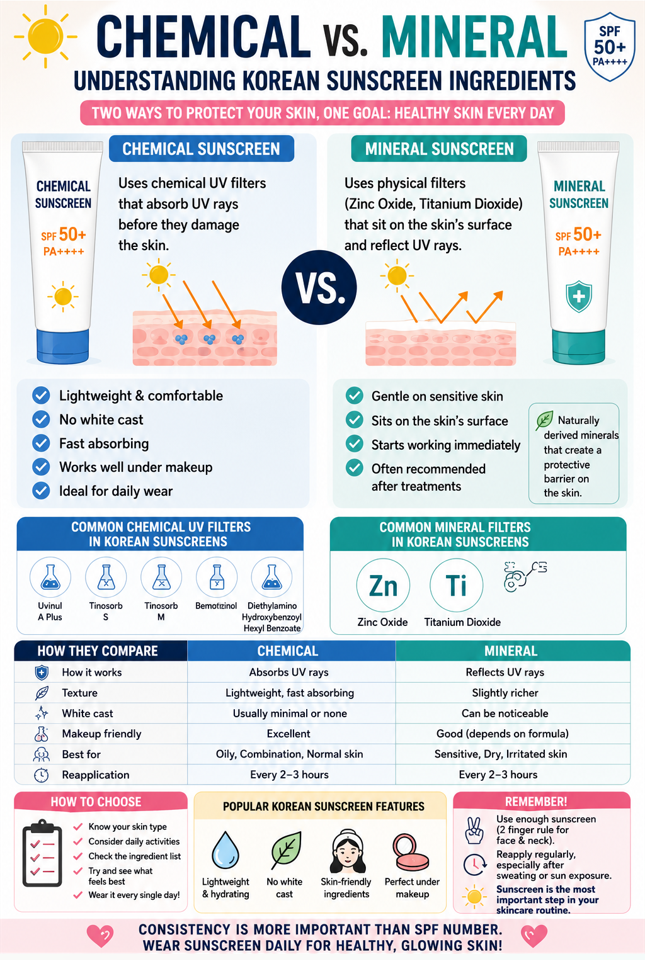
Chemical sunscreens use UV filters that absorb ultraviolet rays before they can damage the skin.
Many modern Korean sunscreens use advanced UV filters that provide high protection while maintaining a lightweight, elegant texture.
Benefits
- Lightweight and comfortable
- Blends into the skin easily
- Usually leaves little or no white cast
- Works well under makeup
- Ideal for daily wear
Best For
- Oily skin
- Combination skin
- Normal skin
- People who wear makeup daily
What Is a Mineral Sunscreen?
Mineral sunscreens use physical UV filters such as Zinc Oxide and Titanium Dioxide.
These ingredients form a protective layer on the skin’s surface to help reduce UV exposure.
Benefits
- Suitable for sensitive skin
- Gentle on the skin barrier
- Starts protecting immediately after application
- Often recommended after certain skincare procedures
Best For
- Sensitive skin
- Dry skin
- Easily irritated skin
- Children and people who prefer mineral filters
Chemical vs. Mineral Sunscreen
| Feature | Chemical Sunscreen | Mineral Sunscreen |
|---|---|---|
| Texture | Lightweight | Slightly richer |
| White Cast | Usually minimal | Can be noticeable |
| Makeup Friendly | Excellent | Good, depending on formula |
| Best For | Daily wear | Sensitive skin |
| Finish | Natural or dewy | Natural or matte |
Modern Korean formulations have improved both types significantly, making them more comfortable than many older sunscreen formulas.
Which One Should You Choose?
Choose a chemical sunscreen if you want:
- A lightweight feel
- No white cast
- Fast absorption
- A sunscreen that layers well under makeup
Choose a mineral sunscreen if you:
- Have sensitive skin
- Prefer fragrance-free formulas
- Want a gentle everyday sunscreen
- Experience irritation with some chemical UV filters
There is no universal winner. The best sunscreen is the one you enjoy wearing every day.
Common Myths
Chemical sunscreens are unsafe.
Modern sunscreen ingredients used in regulated products undergo safety evaluations. Choose products from reputable brands and follow the directions for use.
Mineral sunscreens always leave a white cast.
Older formulas often did, but many newer Korean mineral sunscreens are formulated to reduce visible white residue.
Higher SPF means you only apply once.
No. Sunscreen should be reapplied according to the product directions, especially after sweating, swimming, or extended outdoor exposure.
Frequently Asked Questions
Which sunscreen is better for sensitive skin?
Mineral sunscreen is often preferred because Zinc Oxide and Titanium Dioxide are generally well tolerated.
Which sunscreen works better under makeup?
Many Korean chemical sunscreens are popular because of their lightweight texture and smooth finish.
Can I use chemical sunscreen every day?
Yes. Most Korean chemical sunscreens are designed for comfortable daily use.
Is SPF 50 always better than SPF 30?
Both provide excellent protection when applied correctly. SPF 50 offers slightly higher UVB protection, but proper application and regular reapplication are more important than choosing the highest SPF alone.
Conclusion
Chemical and mineral sunscreens both play an important role in protecting your skin from UV damage. Rather than asking which one is better, consider which one matches your skin type and lifestyle.
If you enjoy wearing your sunscreen every day, you’re much more likely to apply enough and reapply when needed. That daily habit is what makes the biggest difference for long-term skin health.
FAQ
Q: What is the difference between chemical and mineral sunscreen?
A: Chemical sunscreens absorb UV rays using UV filters, while mineral sunscreens use Zinc Oxide and Titanium Dioxide to create a protective barrier on the skin.
Q: Which Korean sunscreen is better for sensitive skin?
A: Mineral sunscreen is often recommended for sensitive skin because its active ingredients are generally well tolerated.
Q: Do chemical sunscreens leave a white cast?
A: Most modern Korean chemical sunscreens leave little or no visible white cast.
Q: Can I wear chemical sunscreen every day?
A: Yes. Many Korean chemical sunscreens are specifically designed for comfortable daily use.