How Long Should You Wait Between Skincare Layers? The Ultimate Guide
If you have ever stood in front of your bathroom mirror, vigorously fanning your face with your hands while wondering if your serum is “dry enough” for moisturizer, you are not alone.
One of the most common questions in the skincare world is whether you need to wait between applying different products. Do you slap them all on in a 30-second rush, or do you need a calculated 15-minute intermission between every bottle?
The truth lies somewhere in the middle. Skincare science reveals that timing is just as crucial as the ingredients themselves. Applying products too quickly can neutralize expensive active ingredients or cause annoying “pilling” (when products roll off in little white flakes). Conversely, waiting too long can lead to unnecessary moisture loss.
Based on dermatological principles and cosmetic chemistry, here is the definitive guide on exactly how long you should wait between your skincare layers to maximize their effectiveness.
The Myth of the “Let Everything Dry” Rule
For years, a common misconception was that every single layer of skincare needed to completely dry before moving on to the next. In reality, most hydrating products actually work better when applied back-to-back on damp skin.
When your skin is slightly damp, it acts like a highly absorbent sponge. If you let your skin dry out completely between your cleanser, toner, and essence, you experience Transepidermal Water Loss (TEWL)—meaning the hydration evaporates into the air rather than sinking into your pores.
However, there are critical exceptions to this rule: Active ingredients and Sunscreen.
Step-by-Step Wait Times: The Breakdown
To make your routine foolproof, let’s break down the ideal wait times between specific product categories, moving from the start of your routine to the finish.
1. Cleanser ➔ Toner
- Wait Time: 0 Minutes (Immediately)
- The Reason: You want to apply your hydrating toner the second you gently pat your face with a towel. Do not let your skin dry out completely. Applying toner to slightly damp skin instantly locks in moisture and preps the skin barrier for the next steps.
2. Toner ➔ Hydrating Serums & Essences (e.g., Hyaluronic Acid, Mucin)
- Wait Time: 0 Minutes
- The Reason: Ingredients like Hyaluronic Acid or Snail Mucin are humectants, meaning they draw water into the skin. They thrive in a damp environment. Layer these hydrators one right after the other while the skin is still dewy.
3. Hydrating Serums ➔ Active Ingredients (Vitamin C, AHA/BHA)
- Wait Time: 1 to 2 Minutes (Until touch-dry)
- The Reason: This is where the waiting game begins. Active ingredients like Vitamin C (Ascorbic Acid) and exfoliating acids (Glycolic, Lactic, Salicylic) are highly formulated to operate at a specific, low pH level. If you immediately apply a neutral moisturizer over them, you alter their pH, effectively neutralizing them and rendering your expensive serums useless. Wait until the active serum feels absorbed and dry to the touch before moving on.
4. Cleansing ➔ Retinol (Nighttime Only)
- Wait Time: 2 to 3 Minutes (Must be completely dry)
- The Reason: Retinol is the exact opposite of a hydrator; applying it to damp skin actually increases its penetration rate too much, which is the leading cause of retinoid-induced redness, peeling, and irritation. Always ensure your face is bone-dry before applying retinol.
- Expert Tip: If you have sensitive skin, use the “Sandwich Method”: apply a light layer of moisturizer, wait 2 minutes, apply retinol, wait 2 minutes, and apply another layer of moisturizer.
5. Serums/Actives ➔ Moisturizer
- Wait Time: 1 Minute
- The Reason: Give your final serum about 60 seconds to sink in. Your moisturizer is designed to be an occlusive shield—it seals everything underneath it. Applying it seals the deal and prevents the active ingredients from evaporating.
6. Moisturizer ➔ Sunscreen (Morning Only)
- Wait Time: 1 to 2 Minutes
- The Reason: If you mix your sunscreen into a wet layer of moisturizer, you dilute the SPF protection and create an uneven shield on your face. Let your moisturizer fully absorb so the skin feels supple but not slippery, then apply your sunscreen.
7. Sunscreen ➔ Makeup
- Wait Time: 3 to 5 Minutes (Crucial)
- The Reason: This is the most important wait time of your entire morning routine. Sunscreen works by forming a protective, invisible film across the surface of your skin. If you immediately drag a makeup brush or foundation sponge over wet sunscreen, you disrupt that film, leaving your skin exposed to UV damage. Waiting 3 to 5 minutes allows the SPF to “set.” This is also the best way to prevent your makeup from pilling.
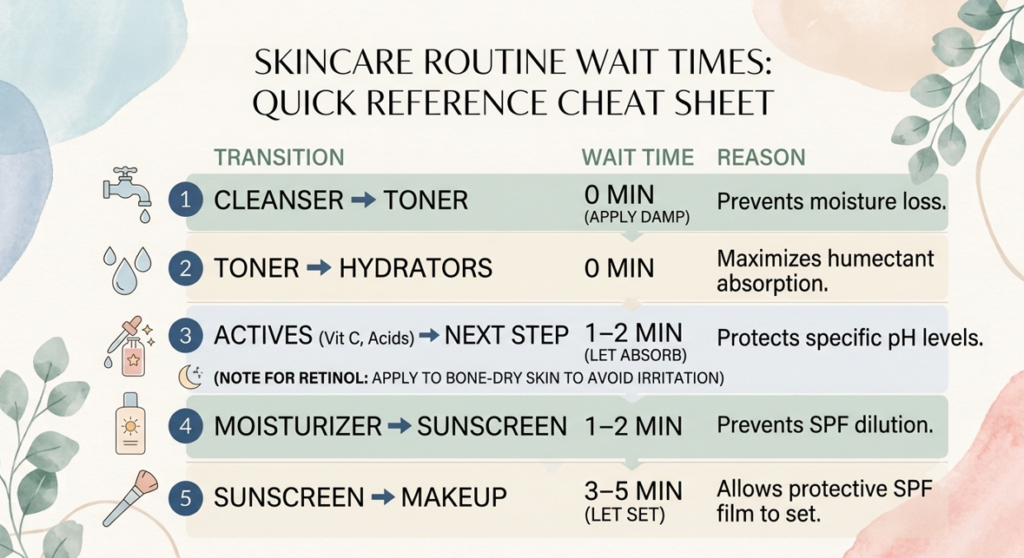
Quick Reference Cheat Sheet
For quick morning or evening reference, keep this timeline in mind:
How to Prevent “Pilling” (When Skincare Rolls Off)
Even if you follow the correct wait times, you might occasionally experience “pilling”—those frustrating, eraser-like shavings that roll off your face when you rub it.
This usually happens for two reasons:
- Rushing: You didn’t wait long enough for heavy, silicone-based products or sunscreens to dry, creating a slippery sludge.
- Product Clashing: You are mixing an oil-based product with a water-based product, or layering too many products containing heavy silicones (like Dimethicone).
To avoid pilling, adhere strictly to the “thinnest to thickest” application rule, give your final layers adequate time to dry, and gently pat your products into the skin rather than aggressively rubbing them.
Frequently Asked Questions (FAQ)
Q1: Can I use a fan to speed up the drying time between layers?
Yes, using a handheld fan is a very popular technique in the beauty community! Fanning your face for 10-15 seconds can help speed up the drying time for active ingredients (like Vitamin C or AHA/BHA) or setting your sunscreen, saving you valuable time in your morning routine.
Q2: Do I have to wait if I am only using hydrating products?
No. If your routine consists solely of a gentle cleanser, a hydrating toner, a hyaluronic acid serum, and a basic moisturizer, you do not need to wait between any of those steps. Slathering them on back-to-back on damp skin will actually give you a plumper, more hydrated complexion.
Q3: What happens if I don’t wait after applying Vitamin C?
Because Vitamin C is highly acidic, applying a cream immediately over it can raise its pH level too quickly. While it won’t necessarily damage your skin, it severely diminishes the efficacy of the Vitamin C, meaning you won’t get the brightening and antioxidant benefits you paid for.
Q4: Should I wait between different types of serums?
If you are layering two purely hydrating serums (e.g., a calming centella serum and a hyaluronic acid serum), you do not need to wait. However, if one of the serums is an active treatment (like a niacinamide pore-refining serum), it is best to let it absorb for about 60 seconds before applying the next one.